
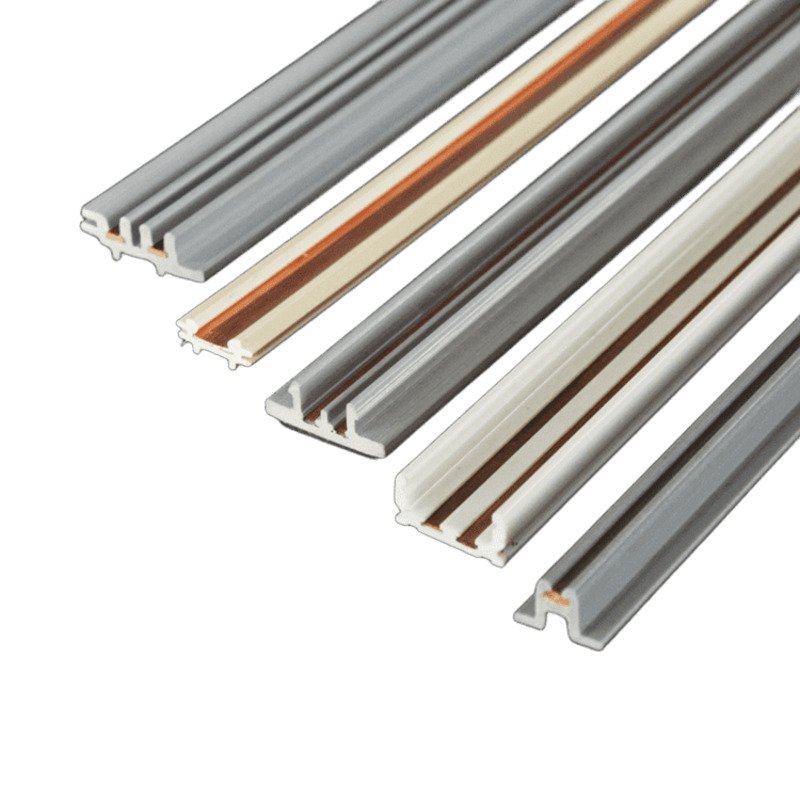
Engineers often struggle with integrating electrical conductors into complex product designs, facing bulky external wiring and length restrictions. This can lead to increased assembly costs, more potential points of failure, and compromised product aesthetics. Co-extruded conductive profiles solve this by combining copper conductors and plastic insulation into a single, unified component from the start.
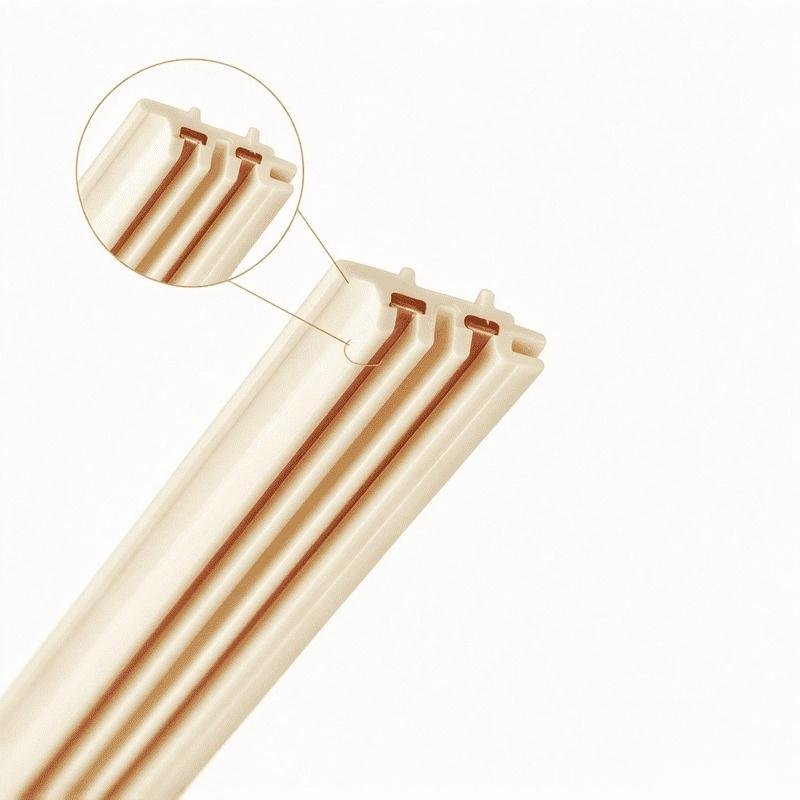
Co-extruded conductive profiles are custom-manufactured components where one or more copper conductors are seamlessly embedded within a plastic profile during a continuous extrusion process.1 This creates a single, integrated part that provides both electrical conductivity and structural insulation, eliminating the need for separate wiring and assembly steps.
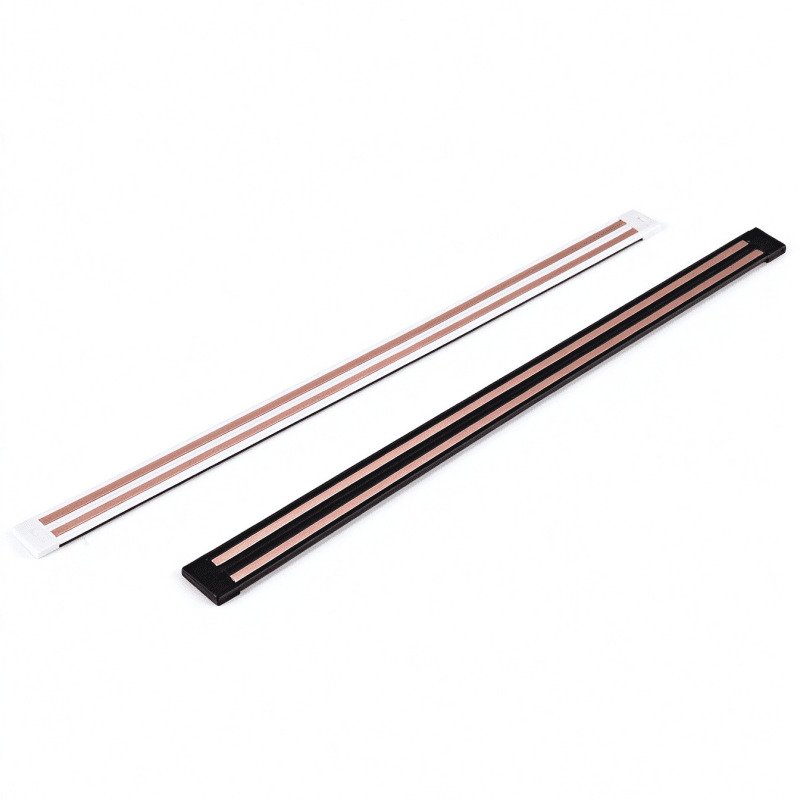
This unique manufacturing method unlocks design possibilities that are simply not feasible with traditional approaches. But how do you know if it's the right choice for your project? Let's explore the key considerations for evaluating and specifying these highly functional components.
How Do Co-Extruded Conductive Profiles Overcome Design Limitations?
Are you frustrated by the design compromises forced by standard wires and separate plastic channels? These traditional methods often limit component length, complicate assembly, and create a cluttered final product.
Co-extruded conductive profiles directly address these issues by enabling continuous, theoretically unlimited lengths2 and embedding the conductive element directly into the product’s structural form.
Dive Deeper
In my experience helping clients assess manufacturability, two major "aha!" moments occur when they grasp the potential of this technology. One is about length, the other is about integration.
Unlocking Continuous Lengths
Traditional methods of creating a conductive track, like manually inserting a copper wire into a pre-molded plastic housing, are limited by the length of the housing you can practically produce and handle3. This often forces designers to join multiple sections, creating weak points and additional assembly labor.
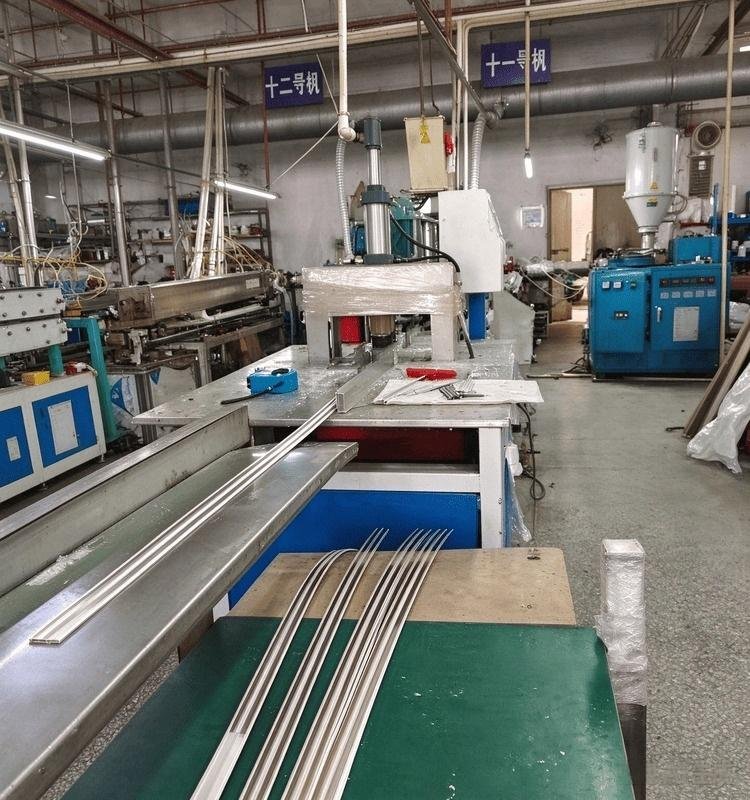
Co-extrusion is a continuous process. Raw plastic pellets and copper wire are fed into the machine, and the finished profile comes out the other end. The only real limitation on length is how you plan to ship and handle the final part. This is a game-changer for applications like:
- Architectural and commercial lighting: Long, uninterrupted power and signal tracks for LED strip systems.
- Industrial busbar systems: Continuous power distribution rails inside machinery or control cabinets, eliminating joints.
- Conveyor systems: Integrated power and data lines running the full length of the system.
Achieving Seamless Structural Integration
The second major advantage is that the conductor is no longer an afterthought. It becomes an intrinsic part of the plastic profile. The profile's geometry can be custom-designed to serve multiple functions—acting as a housing, a mounting bracket, a seal, and a conductor all at once.
This level of integration allows you to:
- Reduce Part Count: A single co-extruded profile can replace a separate plastic channel, copper wire, fasteners, and insulators.
- Simplify Assembly: You eliminate the manual steps of routing wires, securing them, and enclosing them. This drastically cuts down on labor costs and reduces the chance of assembly errors4.
- Improve Reliability: By embedding the conductor, you protect it from abrasion, moisture, and vibration5. There are no external connections to work loose over time. I've seen many projects where this shift from external wiring to an integrated profile solved persistent field failure issues.
Why Is Material Selection So Critical for Co-Extruded Conductive Profiles?
Thinking you can just pick any plastic and any copper wire? This approach can lead to catastrophic failure, from overheating to structural breakdown6, because the materials don't work together as a system.
Choosing the right materials for co-extruded conductive profiles is a balancing act. You must match the plastic's properties (insulation, temperature resistance, rigidity) with the copper's requirements (conductivity, size) for your specific application.
Dive Deeper
There is no universal "best" material combination. The optimal choice is always a trade-off engineered for a specific use case. The process starts with defining your operational requirements, which then dictates the material system.
The Insulating Plastic Substrate
The plastic's primary role is electrical insulation, but it also provides the profile's structure, environmental resistance, and appearance. Here are some common choices and their trade-offs:
| Plastic Material | Key Characteristics | Best For... |
|---|---|---|
| PVC (Polyvinyl Chloride) | Cost-effective, good electrical insulation, flame retardant. | General-purpose applications, cost-sensitive projects, indoor environments. |
| ABS (Acrylonitrile Butadiene Styrene) | Good impact strength and rigidity, good surface finish. | Housings and structural components requiring durability. |
| PC (Polycarbonate) | High impact resistance, excellent temperature stability7, transparent options. | Demanding environments, lighting lenses, applications requiring high heat resistance. |
| Modified Engineering Plastics | Custom-formulated for specific properties like UV resistance, enhanced chemical resistance, or higher flexibility. | Outdoor use, medical devices, or unique industrial applications. |
When we evaluate a client's drawing, the first questions are about the operating environment: What is the maximum temperature? Will it be exposed to UV light or chemicals? Does it need to meet a specific flammability rating like UL94-V0? The answers narrow down the appropriate plastic.
The Conductive Copper Core
For the conductor, the key variables are the grade of copper and its cross-sectional area.
- Grade: Higher purity copper offers better conductivity but may be softer8. Alloys can be used for added strength if the conductor is also a structural element.
- Cross-Section: This is the most critical factor for electrical performance. A larger cross-section can carry more current (amperage) and generates less heat. We work with clients to calculate the required size based on their power requirements, duty cycle, and the thermal properties of the surrounding plastic. Sizing it too small is a serious fire hazard9.
What Makes the Manufacturing Process So Important?
A profile might look perfect coming off the line, but a poor manufacturing process can hide defects that lead to failure months or years later. Why is the process just as important as the materials?
The reliability of co-extruded conductive profiles depends entirely on the quality of the bond between the copper and the plastic. A flawed process results in a weak bond, which can cause delamination, moisture ingress, and electrical failure.
Dive Deeper
Sourcing co-extruded parts is an exercise in engineering vetting, not commodity procurement. You are not just buying a shape; you are buying a supplier's process control. I've often told clients that the most important questions they can ask are about how a supplier manages the manufacturing process.
The Critical Copper-Plastic Bond
Copper and plastic are fundamentally different materials. They expand and contract at different rates when heated and cooled (a property called the Coefficient of Thermal Expansion or CTE)10. During the co-extrusion process, both materials are hot. As they cool, the plastic shrinks around the copper.
If this process isn't perfectly controlled, several problems can occur:
- Poor Adhesion: The plastic may not form a void-free, watertight bond with the copper. This can allow moisture to seep in along the conductor over time, leading to corrosion and short circuits.
- Delamination: Stresses from thermal cycling (heating up during use, cooling down when off) can eventually cause the plastic to pull away from the copper.
- Stress Cracking: If the process parameters are wrong, high internal stresses can be locked into the plastic part, making it brittle and prone to cracking.
Questions to Ask Your Manufacturing Partner
To mitigate these risks, your evaluation of a potential supplier should focus on their engineering capability. Here are some questions I recommend asking:
- How do you prepare the copper surface before extrusion? A clean, properly prepared surface is essential for good adhesion.
- How do you manage thermal expansion mismatch during cooling? Experienced manufacturers have proprietary techniques for controlling the cooling rate to minimize internal stress.
- What in-process quality controls do you use? Ask about real-time monitoring of dimensions, surface quality, and the stability of process parameters like temperature and pressure.
- How do you validate the bond quality? This could include destructive testing (pull tests, cross-section analysis) on samples from a production run.
A capable partner will have confident, detailed answers to these questions. Their ability to co-design, test, and validate the profile is far more valuable than a low price per foot.
Frequently Asked Questions
What is the difference between copper-plastic co-extrusion and overmolding?
Co-extrusion is a continuous process that creates a long profile with a constant cross-section by pushing materials through a die simultaneously.11 Overmolding is a two-step process where a conductor is first placed in an injection mold, and plastic is then injected around it to create a discrete, often complex-shaped part.
Can you bend co-extruded conductive profiles?
It depends. The flexibility is determined by the plastic material, the profile's wall thickness, and the size/shape of the copper conductor. Some profiles can be gently curved, while rigid profiles are meant to be used as straight sections. This must be defined during the design phase.
What are the typical costs associated with these profiles?
Cost is driven by material choice (specialty plastics are more expensive), the amount of copper used (a major cost component), the complexity of the profile shape, and order volume. The biggest cost factor is often the one-time tooling (die) investment, which is amortized over the life of the project.
What information do I need to provide for a manufacturability review?
To get an accurate assessment, you should provide a detailed drawing with dimensions and tolerances (a CAD file is best), the required electrical specifications (current, voltage), the operating environment (temperature, chemical exposure), and any applicable regulatory standards (e.g., UL, RoHS, REACH).
Conclusion
Ultimately, selecting co-extruded conductive profiles is not about finding a part in a catalog; it's a strategic engineering decision. By integrating conductors directly into a custom plastic profile, you can overcome the length and assembly limitations of traditional wiring, resulting in a cleaner, more reliable, and often more cost-effective product design. Success hinges on treating the profile as a complete system, where material selection and the manufacturing process are just as critical as the geometry. The key is to partner with a manufacturer who has the engineering expertise to help you navigate these trade-offs and validate a solution built for your specific application.
If you are developing a product that could benefit from an integrated conductive solution, our engineering team is ready to help. Contact us to review your design and discuss the manufacturability of your custom profile.
"Multilayer Coextrusion of Polymer Composites to Develop ...", https://www.osti.gov/servlets/purl/1110496. The process of co-extrusion involves simultaneously forcing two or more materials through a single die to form a single, integrated profile. When applied to conductors, this embeds a metal wire or strip within a polymer substrate. Evidence role: definition; source type: encyclopedia. Supports: The source should define the co-extrusion process, specifically as it applies to embedding metal conductors within a polymer or plastic matrix.. ↩
"Plastic extrusion", https://en.wikipedia.org/wiki/Plastic_extrusion. Extrusion is a continuous manufacturing process, meaning it can theoretically produce a profile of indefinite length. In practice, the final length is dictated by handling, transportation, and installation logistics. Evidence role: mechanism; source type: education. Supports: The source should explain that extrusion is a continuous process, which allows for the production of very long parts, with practical limits determined by post-processing factors like coiling, cutting, and transportation rather than the process itself.. ↩
"How Large Can Injection Molding Parts Be? | Size Guide", https://freeformpolymers.com/how-large-can-injection-molding-parts-be-size-limits-capabilities-guide/. Manufacturing processes such as injection molding are used to create discrete parts, with part size and length being limited by mold size, machine capacity, and material flow characteristics, making them less suitable for producing long, continuous components. Evidence role: general_support; source type: education. Supports: The source should describe the limitations of manufacturing processes like injection molding, noting that they produce discrete parts and are generally not suitable for creating very long, continuous profiles.. ↩
"Cost-benefit analysis of integrated energy system planning ...", http://ui.adsabs.harvard.edu/abs/2020Ene...19216632X/abstract. Design for Assembly (DFA) principles demonstrate that reducing the number of individual parts in a product, for instance by integrating a conductor into a structural profile, directly correlates with reduced assembly time, lower labor costs, and a decrease in quality defects. Evidence role: statistic; source type: research. Supports: The source should provide data or analysis showing that reducing part count and simplifying assembly steps (e.g., by using integrated components) leads to lower labor costs and fewer opportunities for error.. Scope note: The source may discuss the general principle of part consolidation rather than co-extruded profiles specifically. ↩
"Topic: Electronic/Electrical Reliability", https://users.ece.cmu.edu/~koopman/des_s99/electronic_electrical/. Research on the reliability of electronic and electrical components shows that embedding conductors within a solid polymer matrix, or encapsulation, provides significant protection against environmental factors such as moisture and contaminants, as well as mechanical stresses like vibration and abrasion, thereby reducing failure rates. Evidence role: mechanism; source type: paper. Supports: The source should explain how embedding a conductor within a solid polymer matrix protects it from environmental factors like moisture ingress and mechanical stresses like abrasion and vibration.. ↩
"Modeling Materials Coextrusion in Polymers Additive ... - PMC", https://pmc.ncbi.nlm.nih.gov/articles/PMC9863070/. Technical analyses of metal-polymer composites highlight that improper material selection can lead to critical failures. For example, a polymer with a low thermal conductivity can cause an embedded conductor to overheat under load, while a mismatch in thermal expansion can lead to delamination and structural failure. Evidence role: mechanism; source type: paper. Supports: The source should discuss the importance of material compatibility in co-extruded or composite parts, detailing how mismatches in thermal properties can lead to failures like overheating (due to poor heat dissipation) or mechanical breakdown.. ↩
"Polycarbonate", https://en.wikipedia.org/wiki/Polycarbonate. Material data sheets and engineering resources characterize Polycarbonate (PC) as a thermoplastic known for its exceptionally high impact strength and good thermal stability, maintaining its properties over a wide range of temperatures. Evidence role: general_support; source type: education. Supports: The source should be a material properties database or engineering resource that lists the key characteristics of Polycarbonate (PC), including its high impact strength and heat deflection temperature.. ↩
"Electrical resistivity and conductivity", https://en.wikipedia.org/wiki/Electrical_resistivity_and_conductivity. According to standards from institutions like the Copper Development Association (CDA), higher-purity copper grades exhibit superior electrical and thermal conductivity, while copper alloys are formulated to provide increased mechanical strength, hardness, or other specific properties at the expense of some conductivity. Evidence role: general_support; source type: institution. Supports: The source should detail the properties of different copper grades, showing that higher purity (e.g., C10100 or OFE copper) has higher electrical conductivity but lower hardness and tensile strength compared to alloys.. ↩
"Appliance and Electrical Fire Safety - USFA.FEMA.gov", https://www.usfa.fema.gov/prevention/home-fires/prevent-fires/appliance-and-electrical/. Electrical safety standards, such as the National Electrical Code (NEC) in the United States, specify minimum conductor sizes for given current loads to prevent overheating. An undersized conductor presents a significant fire hazard due to excessive heat generation. Evidence role: expert_consensus; source type: government. Supports: The source should explain the relationship between a conductor's cross-sectional area (ampacity), current, heat generation (Joule heating), and the associated fire risk if the conductor is undersized for the load.. ↩
"Coefficient of Linear Thermal Expansion of Polymers ... - PMC", https://pmc.ncbi.nlm.nih.gov/articles/PMC12693757/. Research in polymer-metal composites confirms that the significant difference in the Coefficient of Thermal Expansion (CTE) between metals and plastics is a primary manufacturing challenge. Uncontrolled cooling can induce high residual stresses, leading to part warpage, delamination at the interface, or stress cracking. Evidence role: mechanism; source type: paper. Supports: The source should explain the concept of Coefficient of Thermal Expansion (CTE) and describe the challenges that arise from the significant CTE mismatch between metals (like copper) and polymers during co-processing, such as residual stress, warpage, and delamination.. ↩
"Coextrusion - an overview", https://www.sciencedirect.com/topics/materials-science/coextrusion. Co-extrusion is a manufacturing technique used to create multi-layered or multi-material extruded products in a single, continuous process. Materials are fed into an extruder and combined in a die to produce a profile with a constant cross-section along its length. Evidence role: definition; source type: encyclopedia. Supports: The source should define co-extrusion as a continuous manufacturing method where multiple materials are extruded through a single die to form a single piece with a constant cross-section.. ↩
Leave a Reply