
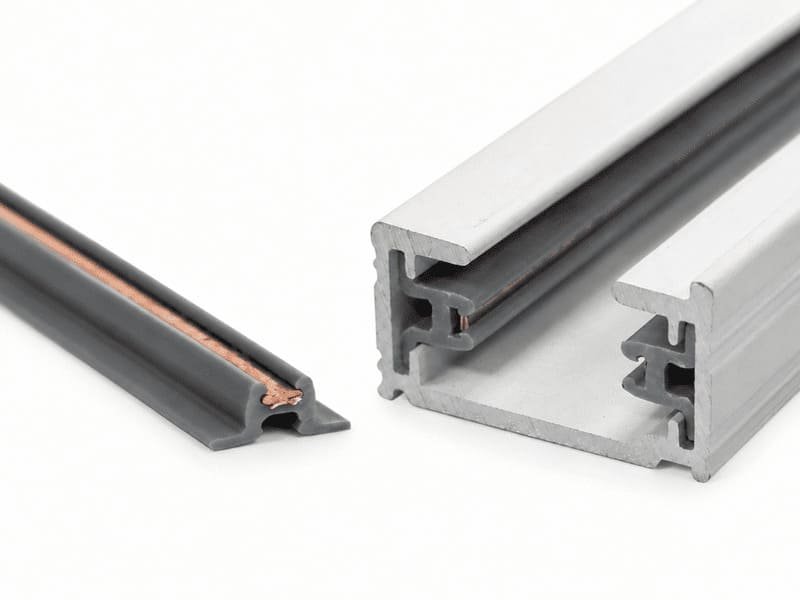
Custom Copper Conductor Strip for Track Lighting Rail
A custom copper-plastic co-extruded conductor strip developed for a Japanese track lighting manufacturer, with controlled rail fit, copper positioning, insulation and copper contact height for reliable electrical connection.
- Challenges Resolved
- 4
- Processes Applied
- 2
- Production Steps
- 5
01 · Project Background
Understanding the Client's Requirements
A well-known Japanese lighting manufacturer required a custom copper conductor strip for its track lighting rail system. The component needed to provide reliable electrical contact for the track light while insulating the copper conductor from the surrounding parts of the rail. The project involved more than simply covering a copper strip with plastic. The complete conductor profile had to remain securely positioned inside the lighting track rail, and the copper conductor itself could not become loose or shift inside the plastic insulation profile. One of the customer's most important requirements was the final position of the copper contact surface after assembly. When the conductor strip was installed into the track rail, the height of the exposed copper surface relative to the plastic insulator had to remain within the required range. If the copper contact surface was positioned too low, the electrical contacts of the installed track light might not reach the copper conductor correctly. This could result in poor, unstable or intermittent electrical connection after the lighting fixture was installed. The project therefore required simultaneous control of electrical conduction, electrical insulation, copper positioning and final assembly dimensions. Rather than evaluating the extrusion profile independently, the conductor had to be developed according to its actual position inside the complete track lighting rail.
02 · Manufacturing Challenges
What Made This Project Technically Demanding
-
Secure Fit Inside the Track Lighting Rail
-
Preventing Movement Between Copper and Plastic
-
Controlling Copper Contact Height
-
Balancing Electrical Conductivity and Insulation
03 · OKAWA Solution
How We Engineered the Answer
OKAWA developed the component using a copper-plastic co-extrusion process that integrates the copper conductor and plastic insulation into one continuous functional profile. The solution focused not only on profile shape, but also on the final position of the conductor inside the customer's lighting track system. Three dimensional relationships were treated as critical during development: copper-to-plastic positioning, plastic-profile-to-rail fit, and final copper contact height after assembly. These relationships directly influenced whether the lighting fixture could establish stable electrical contact. The extrusion tooling was developed to continuously guide the copper strip while forming the insulating plastic around the required areas of the conductor. Controlling the copper feeding position helped reduce unwanted vertical or lateral movement during continuous extrusion. The plastic profile geometry was also adjusted according to the customer's track rail structure. This helped keep the complete conductor strip securely positioned inside the rail after assembly. Sample validation was performed in the assembled condition rather than evaluating the extrusion profile alone. The conductor strip was installed into the corresponding track rail so that the final copper contact position and rail fit could be evaluated together. The development objective was to create one functional profile combining conduction, insulation and mechanical positioning. This approach allowed the copper conductor and plastic insulation structure to work together as part of the final track lighting system.
04 · Production Flow
Step-by-Step Manufacturing Process
-
Step 01
Requirement and Track Structure Review
The customer's conductor structure, track rail and electrical contact requirements were reviewed to identify critical dimensions related to rail fit, conductor position, insulation and copper contact height.
-
Step 02
Profile and Tooling Development
The extrusion profile and tooling were developed around the actual track rail assembly, with particular attention to copper positioning, plastic insulation geometry and the dimensional relationship between conductor and rail.
-
Step 03
Copper-Plastic Co-extrusion Sampling
Initial samples were produced using continuous copper-plastic co-extrusion. Copper feeding position, extrusion stability and profile dimensions were adjusted to maintain the required conductor position.
-
Step 04
Track Rail Assembly Validation
The conductor samples were evaluated after installation into the customer's track rail. Rail fit, conductor stability and final copper contact height were checked in the assembled condition.
-
Step 05
Tooling Adjustment and Production Validation
The extrusion tooling and process parameters were adjusted according to the assembly results until the conductor profile met the customer's dimensional and functional requirements.
05 · Delivery Results
Final Outcomes & Project Value
The final conductor profile met the customer's requirements for track rail assembly, copper positioning, electrical insulation and contact height. The complete conductor strip remained securely positioned after installation into the lighting track rail. The copper conductor also maintained a stable position relative to the surrounding plastic insulation profile. This helped preserve the designed electrical contact position throughout the assembled rail. Controlled copper contact height allowed the electrical contacts of the track lighting fixture to reach the conductor correctly. At the same time, the surrounding plastic structure provided insulation from other rail components. The completed profile integrated three functions into one semi-finished component: electrical conduction, electrical insulation and mechanical positioning. The project demonstrated how copper-plastic co-extrusion can be used for functional components rather than conventional decorative or structural plastic profiles.
Additional Project Details
Why Copper Contact Height Matters in Track Lighting
Reliable electrical connection in a track lighting system depends on both conductivity and conductor position. When a track light is installed, the electrical contacts inside the fixture adapter must physically reach and press against the copper conductor inside the rail.
The height of the copper contact surface relative to the plastic insulator is therefore a functional dimension rather than simply a cosmetic dimension. If the conductor sits below the required position, sufficient contact pressure may not be achieved.
The Relationship Between Rail, Insulator and Copper Position
The final electrical contact position is determined by several components working together.
Track Rail + Plastic Insulator + Copper Conductor Position = Final Electrical Contact Position
This is a typical tolerance stack-up problem in an assembled product. Small dimensional variations between different components can accumulate and influence the final contact position. For general engineering principles related to dimensioning and tolerancing, see the ASME Y14.5 Dimensioning and Tolerancing standard.
Why the Copper Strip Must Remain Fixed Inside the Plastic
Copper positioning directly affects electrical contact consistency. Even if the plastic profile itself remains correctly positioned inside the rail, movement of the copper conductor inside the plastic can still change the effective contact height.
The copper and plastic therefore need to function as one stable component. During copper-plastic co-extrusion, the conductor position, plastic flow and profile geometry all need to be considered together.
Mechanical Stability
The copper conductor needs to resist unwanted movement relative to the plastic insulation profile. Stable positioning helps maintain the designed electrical contact geometry.
Electrical Stability
Stable mechanical positioning contributes directly to stable electrical contact. A conductor that shifts vertically may change the pressure or contact area between the copper strip and the lighting fixture.
Electrical Insulation in Track Lighting Conductors
The plastic profile performs an electrical safety function as well as a mechanical function. It separates the copper conductor from surrounding metal structures while leaving the required electrical contact surface accessible.
The insulation structure therefore needs to be evaluated together with material properties and the complete track design. Relevant electrical products and luminaires may be subject to different safety requirements depending on their destination market. For general luminaire safety requirements, manufacturers can refer to IEC 60598-1:2024 — Luminaires, General Requirements and Tests.
Material compliance requirements also depend on the destination market and the customer’s product specification. For products intended for the European market, applicable requirements may include the EU RoHS Directive and the REACH Regulation. Material compliance should be evaluated according to the actual material, application and customer requirements.
Why Copper-Plastic Co-Extrusion Was Used for This Project
The component needed to perform more functions than a conventional copper strip or plastic extrusion could provide independently. Copper provided the electrical path, while the plastic profile provided insulation, mechanical support and conductor positioning.
Copper-plastic co-extrusion allowed these functions to be integrated during continuous production. Instead of treating the copper and plastic as unrelated parts, the profile could be developed as one functional component.
Functional Integration
The co-extruded profile combines three core functions:
- Electrical conduction — provided by the copper strip.
- Electrical insulation — provided by the surrounding plastic profile.
- Mechanical positioning — provided by the relationship between the copper, plastic profile and track rail.
Designed Around the Final Assembly
The component was developed according to the customer’s complete track lighting rail rather than as an isolated extrusion profile. This made final assembly performance the main validation criterion.
Custom Copper Conductors for Existing Track Lighting Rails
Similar conductor profiles can be developed from an existing product rather than requiring a completely new lighting system design. Customers can provide an existing conductor strip, drawing, aluminum rail sample or complete lighting track sample for evaluation.
Information Useful for Project Evaluation
The most useful information includes the conductor cross-section, copper dimensions, required contact position, rail structure and insulation requirements.
If a complete engineering drawing is not available, an existing physical sample can also be used as the starting point for feasibility evaluation.
- Copper conductor dimensions
- Copper contact area
- Required copper contact height
- Plastic profile geometry
- Track rail cross-section
- Material requirements
- Required profile length
- Estimated production quantity
Frequently Asked Questions
What is the copper strip inside a track lighting rail called?
It is commonly described as a copper conductor strip, track lighting copper strip, copper conducting strip, track rail conductor or insulated copper conductor strip. The exact terminology varies between manufacturers and lighting system designs.
Why is copper contact height important in a lighting track?
The electrical contacts of the track light need to physically reach the copper conductor inside the rail. If the copper contact surface is positioned too low, reliable electrical contact may not be achieved.
Why can’t the copper strip move inside the plastic profile?
Movement between the copper conductor and plastic insulation can change the position of the electrical contact surface. Maintaining a stable positional relationship helps preserve consistent contact geometry.
Why does the conductor profile need to fit securely inside the track rail?
The plastic profile determines the final position of the copper conductor inside the rail. If the complete conductor profile moves after assembly, the copper contact position can also change.
Can you manufacture a conductor strip based on an existing track lighting sample?
Yes. Development can begin from an existing conductor strip, drawing, aluminum track rail or complete lighting track sample. The structure can then be evaluated for copper positioning, insulation, extrusion feasibility and assembly requirements.
Can copper and plastic insulation be produced together?
For suitable structures, copper-plastic co-extrusion can integrate the copper conductor and plastic insulation during continuous extrusion. The specific design needs to be evaluated according to conductor geometry, material and final application requirements.
Need a Custom Copper Conductor Strip for Your Track Lighting System?
If you are developing or modifying a track lighting rail, the conductor profile should be evaluated together with the complete assembly. Copper position, insulation structure, rail fit and contact height can all affect final electrical performance.
Hangzhou Okawa M&E Co., Ltd. provides custom copper-plastic co-extrusion development from drawing or sample evaluation through tooling, sampling, trial production and mass production.
Send us your conductor drawing, existing sample or track rail cross-section for a manufacturing feasibility review.