
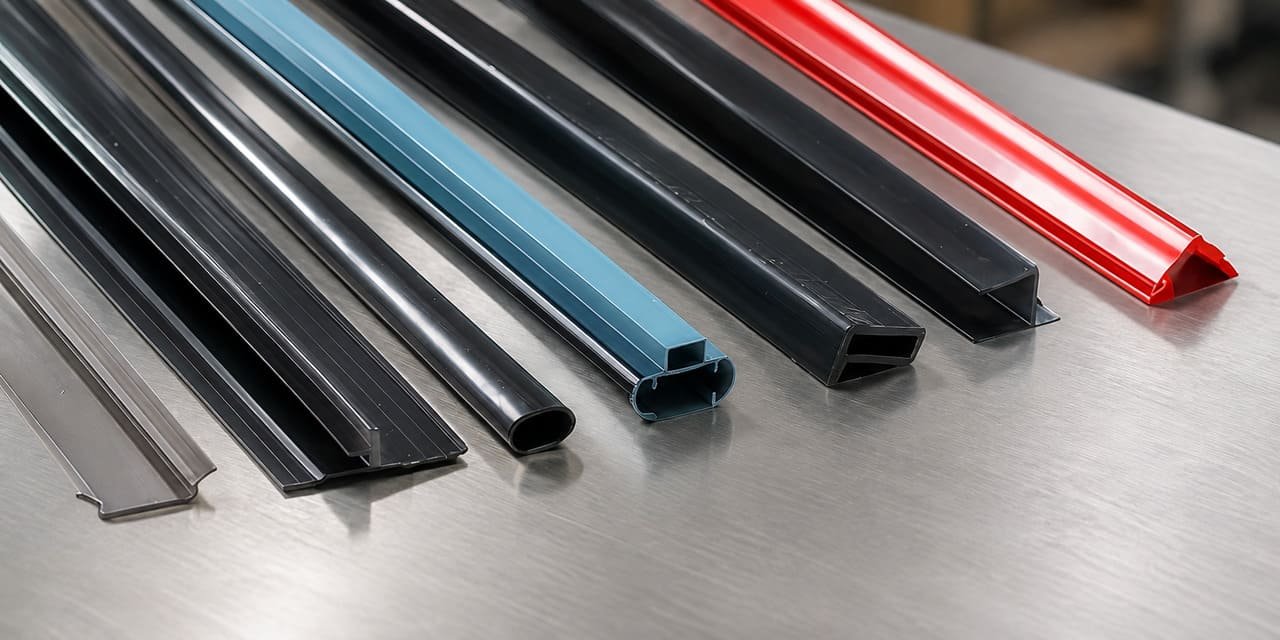
Custom plastic extrusion makes it possible to produce continuous profiles with cross-sections designed around a specific product or assembly. However, a profile that looks straightforward in a drawing is not always straightforward to manufacture consistently.
Wall thickness, geometry, material behavior, dimensional tolerances, cooling and downstream processing can all affect whether a profile can move successfully from prototype to stable mass production.
For engineers and sourcing teams developing an extruded plastic component, considering manufacturability early in the design stage can reduce tooling modifications, shorten sample validation and improve production consistency.
1. Start with the Functional Requirements
Before finalizing the profile geometry, define what the extrusion actually needs to do.
Depending on the application, an extruded profile may provide structural support, insulation, protection, guidance, sealing, decoration or several functions simultaneously.
Important questions include:
- Where will the profile be installed?
- Is it a structural or non-structural component?
- Does it interface with other components?
- Are there critical mating dimensions?
- Will it be used indoors or outdoors?
- Does it require electrical insulation, impact resistance, flexibility or flame-retardant performance?
- Will additional operations be required after extrusion?
Starting from functional requirements makes it easier to determine which dimensions and features are truly critical.
2. Avoid Unnecessary Variation in Wall Thickness
Wall thickness has a significant influence on extrusion behavior.
Large differences between thick and thin sections can lead to uneven material flow and cooling. Depending on the material and geometry, this may contribute to distortion, dimensional variation or difficulty maintaining the intended profile shape.
Where the product design allows, relatively consistent wall thickness generally makes the extrusion process easier to control.
This does not mean every wall must have exactly the same thickness. Complex profiles are possible, but transitions between sections should be evaluated during the design-for-manufacturing stage.
3. Define Critical Dimensions Instead of Over-Tolerancing the Entire Profile
One common issue in custom extrusion projects is applying tight tolerances to dimensions that do not actually affect product function.
Tighter tolerances can increase tooling difficulty, inspection requirements and production cost.
A more practical approach is to identify:
Critical dimensions — dimensions that affect assembly, fit or product function.
Reference dimensions — dimensions that are less sensitive and can accommodate normal extrusion variation.
For example, a groove that mates with another component may require closer dimensional control than an external decorative surface.
Providing this information allows the extrusion manufacturer to focus process control on the dimensions that matter most.
4. Consider Material Behavior During Profile Design
Different thermoplastics behave differently during extrusion, cooling and final use.
Common extrusion materials include PVC, ABS, PC, PE and PP, while modified materials may be considered when specific mechanical, environmental or functional properties are required.
Material selection should consider more than the material name itself.
Relevant factors can include:
- Rigidity or flexibility
- Impact resistance
- Temperature exposure
- Weather resistance
- Flame-retardant requirements
- Surface appearance
- Electrical insulation
- Chemical exposure
- Cost
In many projects, profile geometry and material selection should therefore be evaluated together rather than independently.
5. Think About Assembly During the Extrusion Design Stage
The extrusion is often only one part of a larger product.
If the profile later requires drilling, punching, cutting, printing, assembly or connection with other components, those operations should ideally be considered before the extrusion tooling is finalized.
For example, changing a groove, locating feature or wall thickness during the design stage may simplify downstream assembly.
This is one reason early DFM review can be valuable for custom extrusion projects.
6. Evaluate Whether Multiple Functions Can Be Integrated
Some products that originally require several separate parts may be candidates for co-extrusion or integrated profile design.
Depending on the application, manufacturers may combine different functional regions or materials through processes such as:
- Soft-hard co-extrusion
- Two-color co-extrusion
- Copper-plastic co-extrusion
- Magnetic-plastic co-extrusion
The objective is not simply to make the profile more complex. Functional integration should have a practical manufacturing benefit, such as reducing assembly steps, improving component consistency or simplifying the supply chain.
7. Plan Secondary Operations Before Tooling
Extrusion is not always the final manufacturing step.
Profiles may require secondary operations such as:
- Cut-to-length processing
- Punching or drilling
- Surface protection film
- Printing or marking
- Component assembly
- Custom packaging
When these requirements are known in advance, the extrusion and downstream process can be designed as one manufacturing sequence instead of separate operations.
8. Validate Samples Before Mass Production
Even with a detailed drawing, physical sample validation remains an important stage of custom extrusion development.
A typical development process may include:
Drawing or sample review → manufacturability evaluation → tooling development → initial samples → dimensional and functional validation → trial production → mass production
During sample validation, both the individual extrusion and its interaction with mating components should be checked.
For projects with important assembly requirements, evaluating the actual installation condition can reveal issues that are difficult to identify from drawings alone.
Conclusion
Successful plastic extrusion design is not only about creating the required cross-section. The profile also needs to be practical to manufacture, dimensionally controllable and compatible with downstream assembly.
Considering geometry, tolerances, material behavior and secondary operations early in development can reduce unnecessary tooling changes and help create a smoother path from concept to stable production.
OKAWA supports plastic extrusion projects based on existing drawings, physical samples and new product concepts. Our manufacturing capabilities include plastic extrusion, specialized co-extrusion processes and secondary operations for both standard and custom profile requirements.
Planning a plastic extrusion project? Send us your drawing or sample for a manufacturing feasibility review.
Leave a Reply